2026年3月25日,Emily Hoover等,在《MICROBIOLOGY SPECTRUM》发表题为“Two novel real-time PCR assays for Brucella detection: a specie specific multiplex and a genus-level singleplex developed via large-scale whole genome sequencing data analysis”的论文。
研究要点 布鲁氏菌病作为一种须申报的人畜共患病,对全球经济和公共卫生构成重大挑战,主要由羊种布鲁氏菌(Brucella melitensis)、牛种布鲁氏菌(Brucella abortus)和猪种布鲁氏菌(Brucella suis)分别感染小反刍动物、牛群和猪群引发。 除传统血清学检测和细菌培养外,分子检测技术——尤其是定量PCR(qPCR)凭借其快速检测周期及高灵敏度与特异性受到关注。 然而,利用足够庞大且多样化的数据集验证现有检测方法仍具挑战性,当前亟需能同时鉴定牛种、羊种和猪种布鲁氏菌的可靠多重检测方案。 本研究报道了通过全基因组测序(WGS)数据的大规模比较分析,开发并评估了一种高灵敏度、高特异性的三重qPCR检测技术,可同步检测三种布鲁氏菌,同时设计出新型布鲁氏菌属特异性qPCR检测方法。 通过大型WGS数据集进行的计算机模拟验证显示,这些引物-探针组的灵敏度与特异性达99.8%至100%,表明其计算机模拟性能优于或等同于当前已发表的qPCR方案。 随后使用包含235株经典布鲁氏菌株和192份非经典布鲁氏菌/非布鲁氏菌样本的基因组DNA组合进行评估,该检测体系展现出100%的灵敏度与特异性,并具备优异的低浓度检测能力。 此外,通过先进的细菌DNA富集流程,这些检测方法在组织样本中成功检出布鲁氏菌DNA,展现出卓越的敏感性和诊断准确性。 这些qPCR检测技术为临床标本和细菌培养物中布鲁氏菌种的快速精准诊断提供了重要工具。 图文速览
Table 1 Primers and probes used in this study
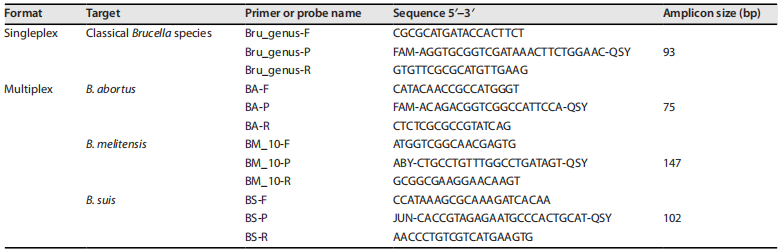
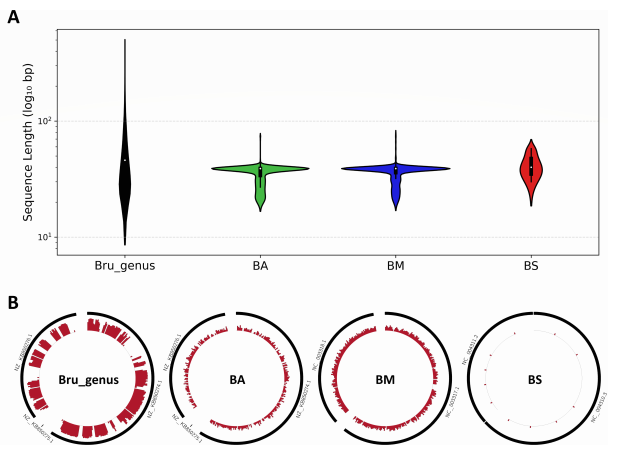
Figure 1 Distribution of lengths and genomic localization of unique core sequences (UCSs) in Brucella species. (A) Distribution of lengths of UCSs identified in the Brucella genus, B. abortus, B. melitensis, and B. suis, respectively. Each violin represents the length distribution of UCSs, displayed on a log10 scale. (B) Genomic distribution of UCSs across the chromosomes of Brucella species. BLASTn-aligned positions were binned into 10 kb non-overlapping windows, and counts were log10-transformed to reflect UCS density. Bru_genus: the Brucella genus primarily includes the classical Brucella species; BA: B. abortus; BM: B. melitensis; and BS: B. suis. The following Brucella reference genomes were used: B. melitensis (GCF_000007125.1), B. suis (GCF_000007505.1), and B. abortus (GCF_000369945.1)
Table 2 In silico analysis of TaqMan-based qPCR assays from this study and previous publicationsf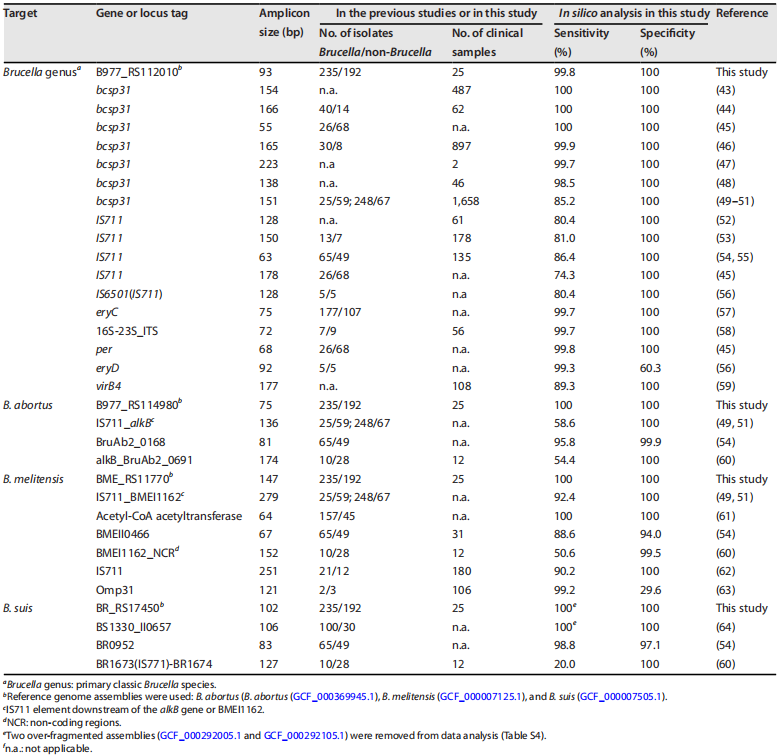
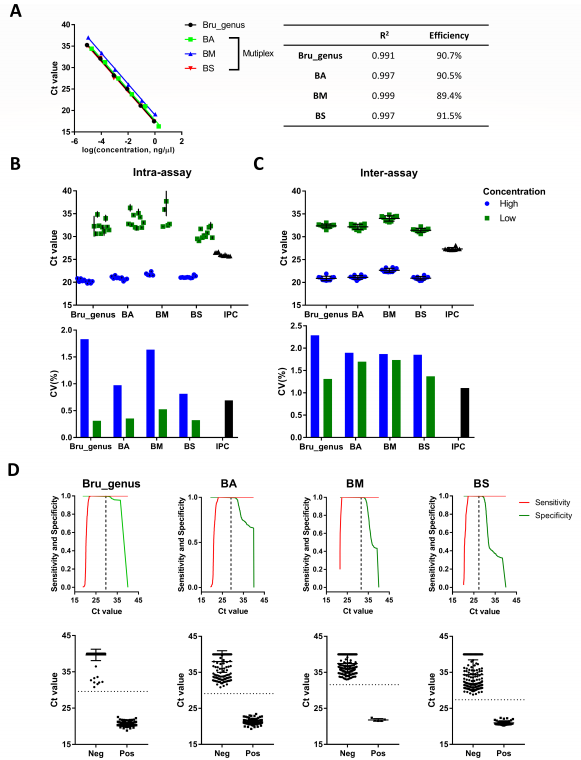
Figure 2 Evaluation of the performance of two novel qPCR assays developed in this study. (A) Standard curves of qPCR assays targeting Brucella genus, B. abortus, B. melitensis, and B. suis. R² and slope values were derived from linear regression analysis, and slope values were used to calculate amplification efficiency. (B and C) Assessment of repeatability (B) and reproducibility (C) of the assays. Repeatability was evaluated across 10 Brucella genomic DNA samples at high (0.1 ng/μL) and low (1 × 10⁻⁴ ng/μL) concentrations(top panel), with the coefficient of variation (CV) calculated per sample and summarized as a mean CV (bottom panel). Reproducibility was assessed using 10 independent replicates of the same sample for each target at high (0.1 ng/μL) and low (1 × 10⁻⁴ ng/μL) DNA concentrations (top panel), and CV values were calculated across replicates (bottom panel). (D) Receiver operating characteristic (ROC) analysis was used to determine optimal Ct cutoff values for each target, balancing sensitivity and specificity. Dashed lines indicate optional cutoffs on the sensitivity-specificity curves (top panel) and Ct distributions (bottom panel). Ct values recorded as “undetermined” in qPCR assays were set to 40 for data analysis. Bru_genus, a genus-specific Brucella qPCR assay targeting classical Brucella species; BA, BM, and BS: a multiplex qPCR assay targeting B. abortus (BA), B. melitensis (BM), and B. suis (BS)
Figure 3 Evaluation of qPCR assay performance using spiked and clinical tissue samples prepared with the Molzym Ultra-Deep Microbiome Prep workflow. (A) Determination of the LOD using logit regression analysis. The LOD was defined as the DNA concentration at which 95% of replicates yielded positive qPCR results. Corresponding Ct cutoff values were derived from the standard curve generated by linear regression of log-transformed DNA concentrations versus Ct values. (B) Detection of B. suis in negative porcine tissue spiked with varying concentrations of B. suis bv. 4 clinical isolates, followed by extraction using the Ultra-Deep Microbiome Prep workflow. The results are shown for both the genus-level singleplex qPCR (left panel) and the B. suis-targeted multiplex qPCR (right panel). (C) Detection of B. suis in clinical porcine tissue samples using the same Ultra-Deep Microbiome Prep workflow. Both the genus-level singleplex (left panel) and B. suis-specific multiplex qPCR (right panel) were used. "Neg" indicates Brucella-negative porcine tissue, and "Pos" refers to culture-positive clinical samples. Ct values recorded as "Undetermined" in qPCR assays were set to 40 for data analysis. Bru_genus, a genus-specific Brucella qPCR assay targeting classical Brucella species; BA, BM, and BS: a multiplex qPCR assay targeting B. abortus (BA), B. melitensis (BM), and B. suis (BS) 附件: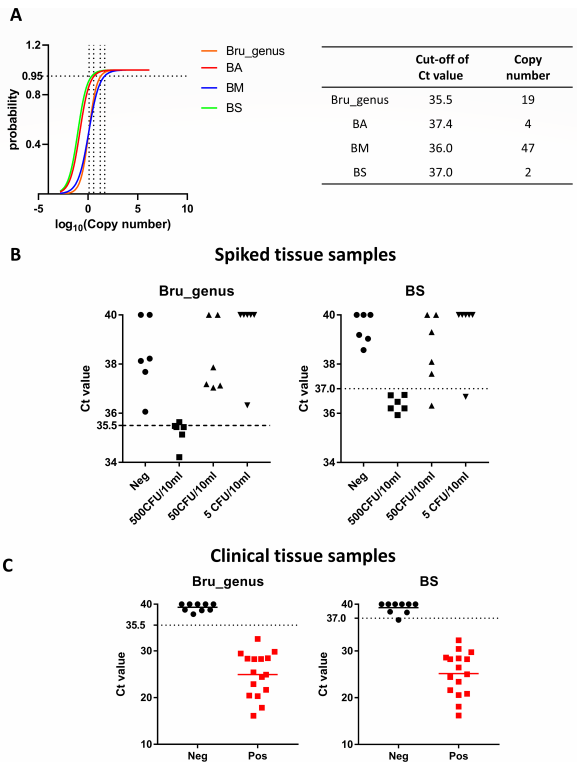
 返回列表
返回列表